
Since opening the People’s Data Project last spring, we’ve been popping up in gatherings around the world to experiment with educational approaches to data justice.
Some workshops focused on understanding how data bias can expose power dynamics that affect our data rights while others focused on experimental tactics to apply data rights in environmental justice contexts. Each one helped participants begin exploring data justice principles and apply them to their own work.
Our audiences ranged from international human rights defenders to public school teachers to environmental activists. We’ve validated a core belief in this work that data justice is necessary in any context where people are fighting to reclaim power for their communities from harmful data-backed systems.
Learning Fundamentals
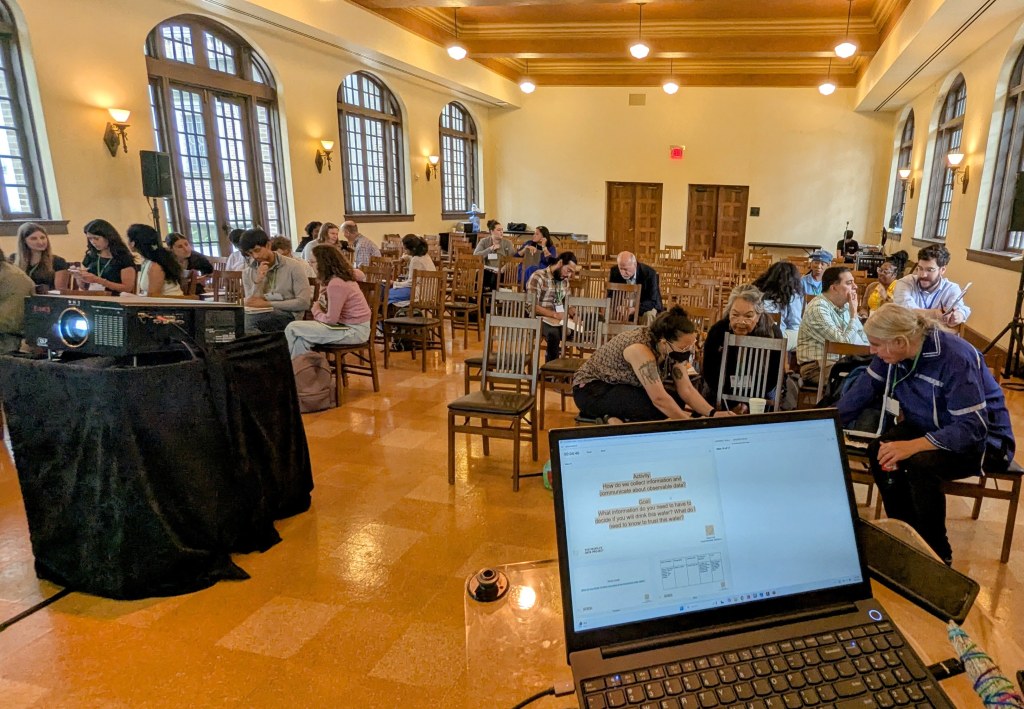
At the Twin Cities Innovation Alliance’s Data for Public Good 2025 conference, we came together with students, educators, and advocates from across the country to share strategies for data justice. Our workshop on understanding data rights focused on core concepts of data rights, data bias, and tactics for data defense.
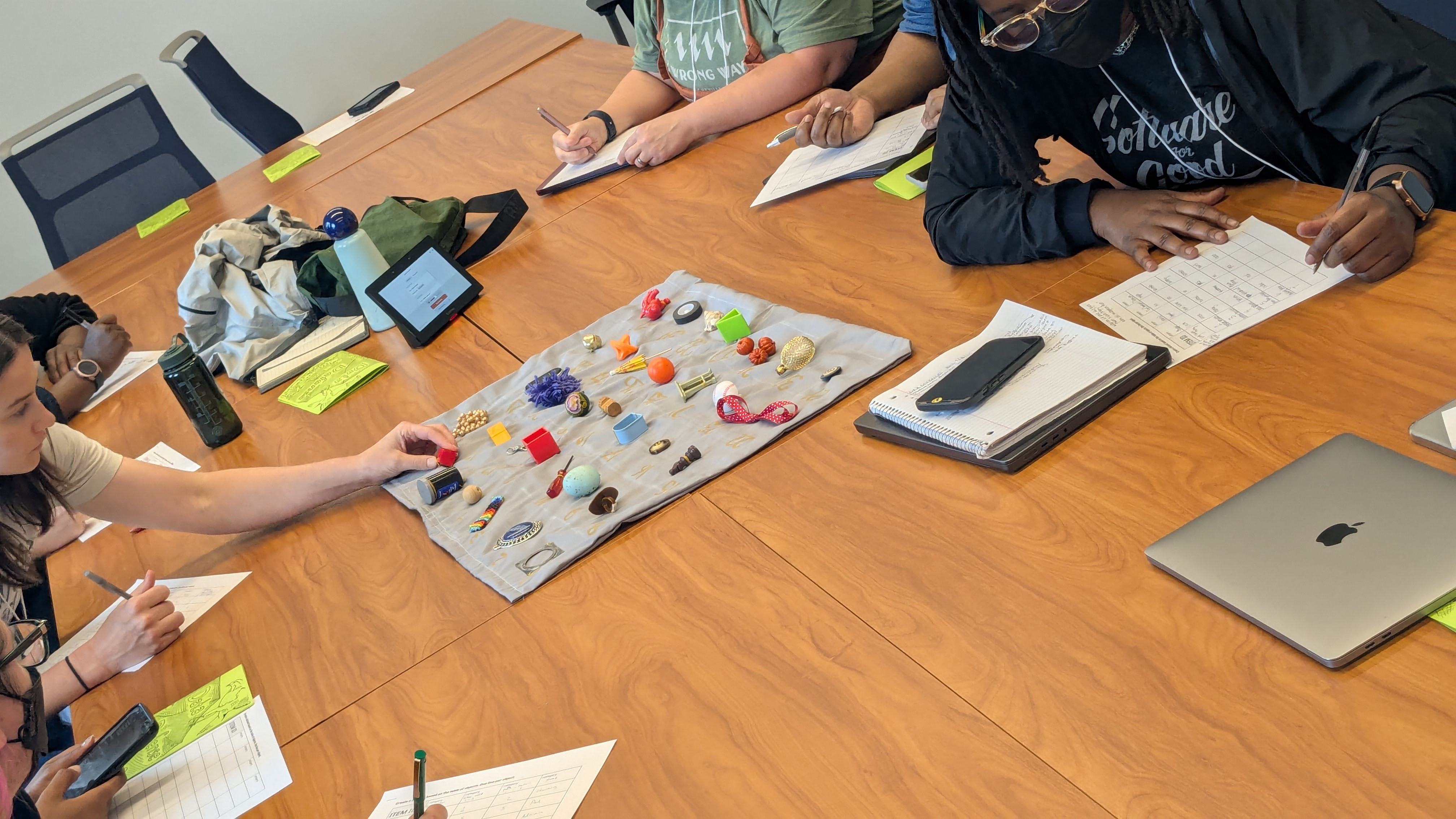
Participants were invited to create their own “analog datasets” based on an assortment of disparate items and assess how their personal perspectives and worldviews informed the vastly different interpretations of physical objects as “data.” Participants with children measured how many objects were choking hazards. Participants with experience in data analysis used standardized numerical indices to rate objects based on various scales like hardness or roundness.
“I want to share this activity with my students so they can see how bias shows up in data that’s collected about them.”
Participant of “Understanding Data Rights” workshop
Ultimately, participants were told that each dataset would be evaluated based on whether it accurately captured information on arbitrary characteristics like “number of orange pieces” or “number of metal pieces.” Would they still collect information the same way as before knowing that these would be the evaluation standards? Most said no.
Understanding Data Rights & Tactics for Data Defense
Data for Public Good, Twin Cities, Minnesota, July 2025

Our lens, or our bias, informs how we collect information. Nonprofits, schools, and other community based groups are encouraged to collect data about their communities for higher-ups to evaluate metrics based on test scores, social impact, or policy outcomes. The metrics that serve funders’ and executives’ interests shape how we collect information that, if collected through more community-based methods, could have been a powerful tool for understanding and local knowledge.
Environmental Justice Workshops
Data justice has an important role to play in helping communities protect their lands and the environment. Building on principles of Indigenous Data Sovereignty, the way that we document and use information about our environment has implications for how we might live in alignment to natural systems.
When environmental justice advocates shift their approaches to data, from top-down strategies toward grassroots, rights-preserving strategies, they can reshape dominant narratives presented by governments and industries that profit from contaminating soil, air, and water, and unlimited extraction of natural resources.
Better Data for EJ: Data Rights and Community Data
Environmental Justice Data & Mapping Symposium, Houston, Texas, July 2025
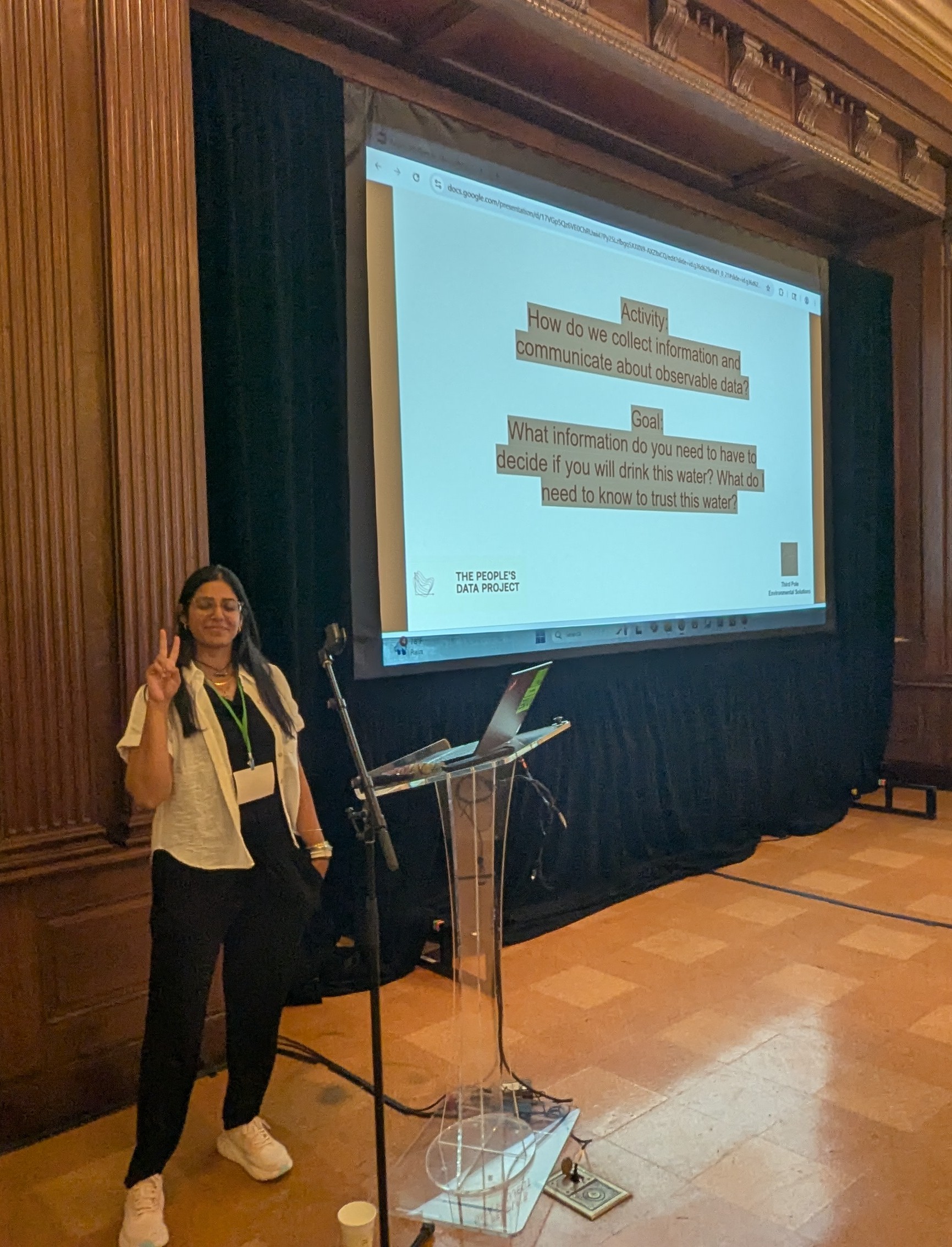
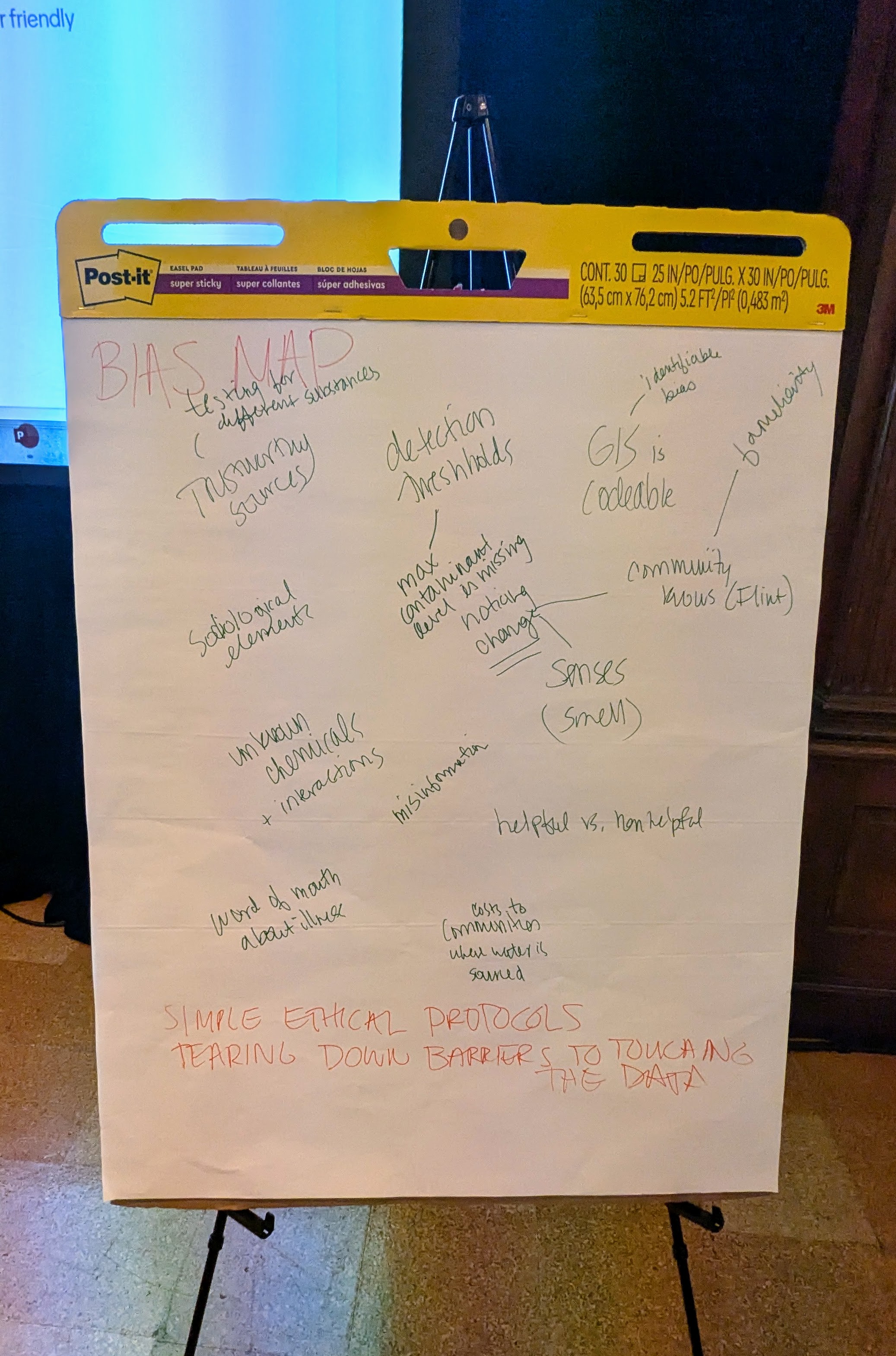
The People’s Data Project teamed up with Mashal Awais, principal and founder of Gulf Coast-based mapping firm Third Pole Solutions, to provide a workshop on data justice approaches to environmental justice. At the Environmental Justice Data & Mapping Symposium hosted by FracTracker Alliance and the Bullard Center for Environmental Justice at Texas Southern University, we invited participants to think through how data about environmental issues is collected, focusing on water quality. We explored together how advocates might take steps to ensure that community narratives are represented in environmental data.
“When we talk about people’s observations of their environment, we’re saying they’re noticing a change over time in things like smells or appearance, which should be considered data.”
Participant of “Better Data for EJ” workshop
By walking through an activity to identify data sources relevant to water quality assessments and expanding our search into qualitative or cultural knowledge sources, participants noted that certain data sources would not be considered “legitimate” or “rigorous” by institutions with policymaking power — even if they would be sufficient to help communities better understand environmental issues in their backyard. Mapping different ways that power players manipulate bias in environmental data collection encouraged a lively discussion about ways to fight back against suppression of community data that could bring light to important narratives around issues like water contamination.
Data Has a Beating Heart: Embodied Data for EJ Landscapes
RightsCon, Taipei, Taiwan, February 2025

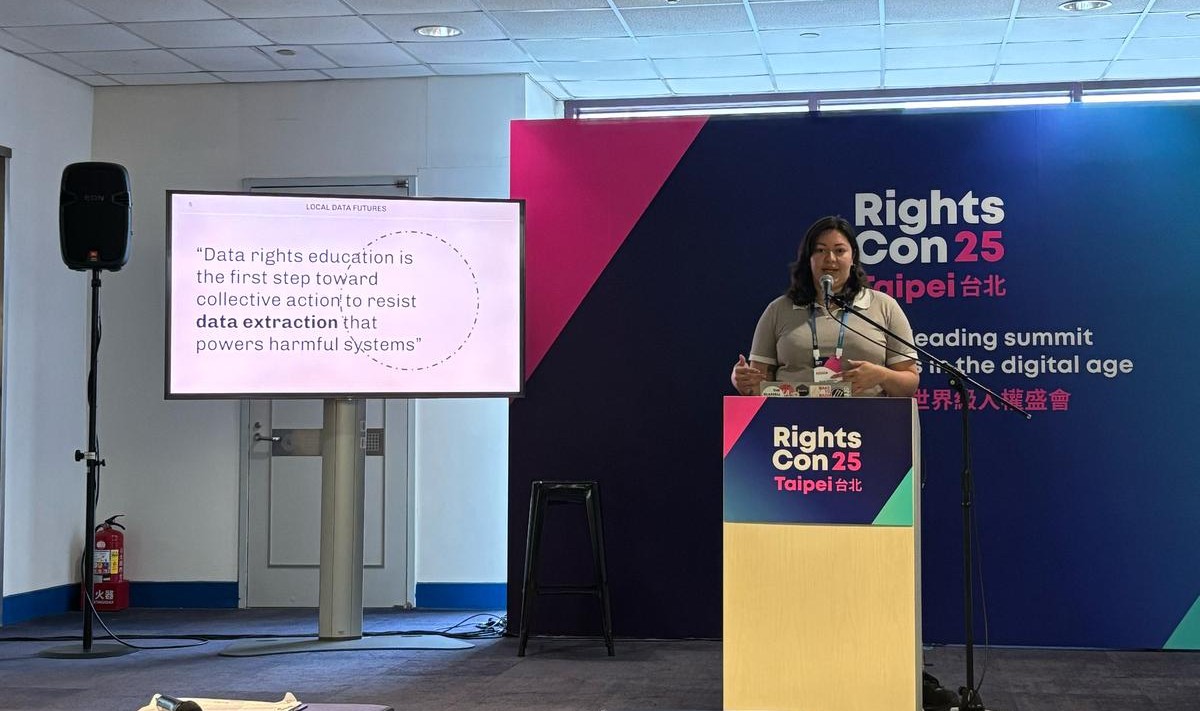
Embodied data is the antidote to unjust data narratives constructed in spaces of institutional power that fail to reflect peoples’ lived experiences. We teamed up with Emelia Williams from the Open Environmental Data Project to help attendees at RightsCon explore ways to incorporate an awareness of data rights into their work in order to strengthen their advocacy.
We walked participants through a set of scenarios that highlighted points of data extraction or data injustice in environmental justice organizing contexts. Participants were invited to discuss each scenario and review a menu of environmental justice tactics and determine which ones were appropriate for the context. This exercise helped people who were already engaged in community environmental justice campaigns think through ways that data was being used by power players to create challenges, and begin brainstorming ways to reclaim power over data-driven narratives or the data itself.
Evolving the Practice
The People’s Data Project has multiple workshops planned for coming months and will continue creating foundational materials and tools for community organizers and their allies to apply data justice in real-world contexts. The questions ahead involve searching for ways to identify replicable strategies and frameworks to spread data rights across communities, including exploring direct consulting with community organizations or train-the-trainer style educational models.
Open questions guiding our reflective learning:
- What are the learning modules that might take workshop participants beyond data rights 101?
- How do we use education to popularize language and definitions around data justice that have yet to be widely understood?
- Which audiences are most eager to put data rights principles into practice and what learning tools or resources do they need?
Learn more about the People’s Data Project by reaching out to connect or following us on Instagram.
 The People's Data Project
Leave a comment